
Interview center
Walk in prepared. Walk out hired.
Step 1 · Planning
Your 7-day interview preparation plan
Days 1–2
Research & CV
- Read the job description and highlight every skill it mentions
- Study the company: products, customers, recent news, annual report
- Tailor your CV so the top third matches the role
- List 3 projects you can talk about for 2 minutes each
Days 3–4
Technical drills
- Solve 15–20 SQL problems (joins, GROUP BY, CTEs, window functions)
- Revise Excel: XLOOKUP, pivot tables, IF/SUMIFS
- Rebuild one Power BI/Tableau dashboard from scratch
- Review statistics: mean/median, distributions, A/B testing, p-value
Day 5
Stories & introduction
- Write your 60–90 second introduction and time it
- Prepare 5 STAR stories: challenge, conflict, mistake, leadership, impact
- Prepare 3 smart questions to ask the interviewer
Day 6
Mock interview
- Record yourself on your phone answering 10 questions
- Watch it back: posture, filler words, eye contact, pace
- Do one mock with a friend or mentor and ask for honest feedback
Day 7
Rest & logistics
- Prepare outfit, printed CVs, ID, pen and notebook
- Test camera, mic, internet and lighting for online interviews
- Plan travel to arrive 10–15 minutes early
- Sleep well — no new topics tonight
Study hours per stage
Typical focus of a data analyst interview
- HR screening · 15%
- Technical (SQL/Excel) · 35%
- Case / dashboard task · 25%
- Behavioural & culture · 25%
Indicative guide based on common hiring processes — weights vary by company.
Step 2 · Watch
7 best YouTube videos to prepare




Step 3 · Introduce yourself
The 4-part “Tell me about yourself” formula
Present
Who you are today — degree or current role, in one line.
“I'm a BS Statistics graduate from Punjab University, currently working as a junior MIS executive.”
Past
The skills and experiences that prepared you for this role.
“Over the last year I learned SQL, Excel and Power BI and built three portfolio projects, including a sales dashboard for a local retailer.”
Proof
One result with a number.
“That dashboard cut their weekly reporting time from 6 hours to under 1 hour.”
Future
Why this company and role, specifically.
“I'm excited about this role because your team uses data to improve customer retention — exactly the problem I enjoy solving.”
Keep it 60–90 seconds. Practise until it sounds like a conversation, not a script.
Step 4 · Present your CV
How to present your CV with confidence
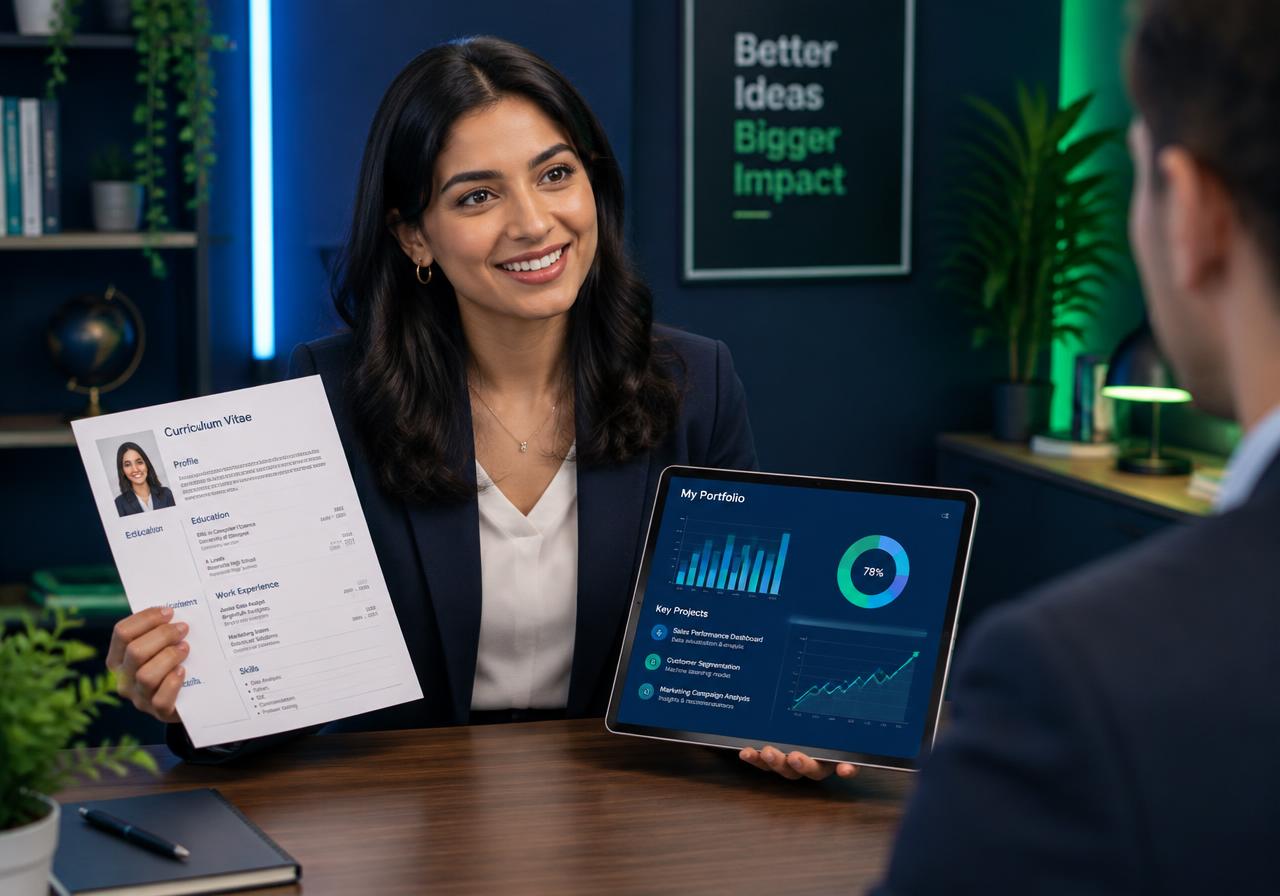
- 1Keep it to 1 page (2 if you have 5+ years). Clean font, no photos of tables or graphics-heavy templates — ATS systems can't read them.
- 2Top section: name, phone, email, LinkedIn, portfolio/GitHub link and city.
- 3A 2–3 line summary tailored to the job title you are applying for.
- 4Skills grouped: Tools (SQL, Excel, Power BI, Python), Concepts (data cleaning, KPIs, A/B testing).
- 5Projects with impact bullets: action verb + what you did + measurable result.
- 6Bring 2–3 printed copies in a folder; never fold the CV.
- 7In the room, walk them through it top-to-bottom in 60 seconds, then point to the project most relevant to them.
- 8Know every line — anything on your CV is fair game for a question.
Step 5 · Body language
Eye contact, posture and voice — do’s & don’ts
Posture
Sit upright, back against the chair, lean slightly forward when listening.
Slouching, crossing arms, leaning far back.
Eye contact
Hold eye contact ~60–70% of the time; in panels, look at the questioner then include others.
Staring at the table, ceiling or constantly at notes.
Hands
Rest hands on the table or lap; use open palms when explaining.
Clicking pens, touching face or hair, fidgeting.
Voice
Speak slightly slower than normal, pause before answering, end sentences firmly.
Rushing, mumbling, rising tone that sounds like a question.
Face
A natural smile at greeting and when listening; nod to show understanding.
A blank expression or forced constant grin.
Online
Camera at eye level, look at the lens when speaking, light in front of you.
Looking at your own video, noisy background, backlight from a window.
Step 6 · Stand confident
8 steps to stay calm and confident
- 01Arrive early and use the 10 minutes to breathe slowly: 4 seconds in, 4 hold, 6 out.
- 02Stand tall in an open posture for two minutes before you enter.
- 03Greet everyone by name with a firm handshake (if appropriate) and a smile.
- 04It's fine to say: "Let me think for a moment" — silence beats a rushed answer.
- 05If you don't know something, say how you would find out. Honesty builds trust.
- 06Treat it as a conversation between two professionals, not an exam.
- 07Close strongly: summarise why you fit, thank them, and ask about next steps.
- 08Send a thank-you message within 24 hours.
Step 7 · Practise
28 interview questions with model answers
Answer out loud before opening each card — that's how real interviews feel.
Quick FAQs
Fast answers to common worries
60 to 90 seconds. Practise with a timer until it feels natural, not memorised.
Want a live mock interview?
Message DataUpto on WhatsApp to practise with a mentor and get honest feedback.
Book a mock interview on WhatsApp